
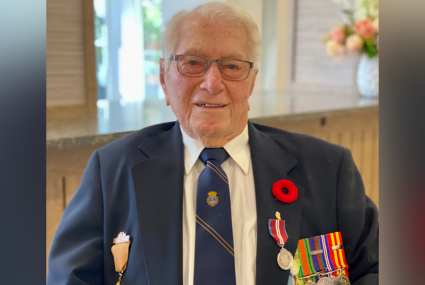
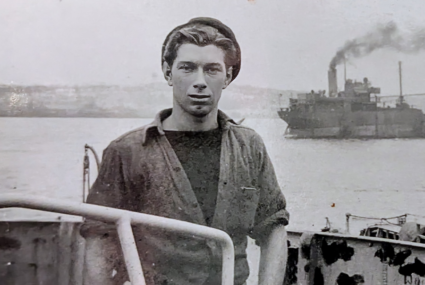
If you ask Les Nelson about his military service in World War II, the 104-year-old will answer with classic Canadian modesty. “Not much to say, really,” he says in a matter-of-fact tone. “I spent four and a half years in the Navy during the Second World War…it was just little things.”
In reality, ‘just little things’ meant braving U-boat-patrolled oceans, chilly night watches in search of enemy ships, problem-solving engine issues in the fug of diesel fumes, and plunging into icy waters as a deep-sea diver. Even when the uniform came off, his commitment to service never stopped. He spent over three decades fighting fires as a Vancouver fire captain, shared nearly 70 devoted years with his wife, Joan, and they raised three wonderful children together.
As Remembrance Day approaches, Les’s story is a reminder that the people who gave us our future rarely think of themselves as heroes—making it all the more essential that we do. Les’s roots run deep in the local soil.
From the Banks of Canoe Pass to the Open Sea
Born in 1922 at the Guichon Hotel in Port Guichon (West Ladner), he was raised on his grandparents’ riverside cattle farm at Canoe Pass alongside their 13 children. At age 12, he moved to Kitsilano Beach to live with his father, and at 15 started work as a house painter.
By 1941, the world was deep in the throes of the Second World War. Facing the draft at age 19, Les chose his own course. “If you didn’t join up, they were going to put you in the Army,” Les recalls with dry wit. “I didn’t want to be in the Army…so I picked the Navy.”
Enlisting with the Royal Canadian Naval Volunteer Reserve (RCNVR) in Vancouver, Les completed basic training before journeying across the country to Halifax and across the Atlantic to Scotland, where many Canadian sailors were stationed.
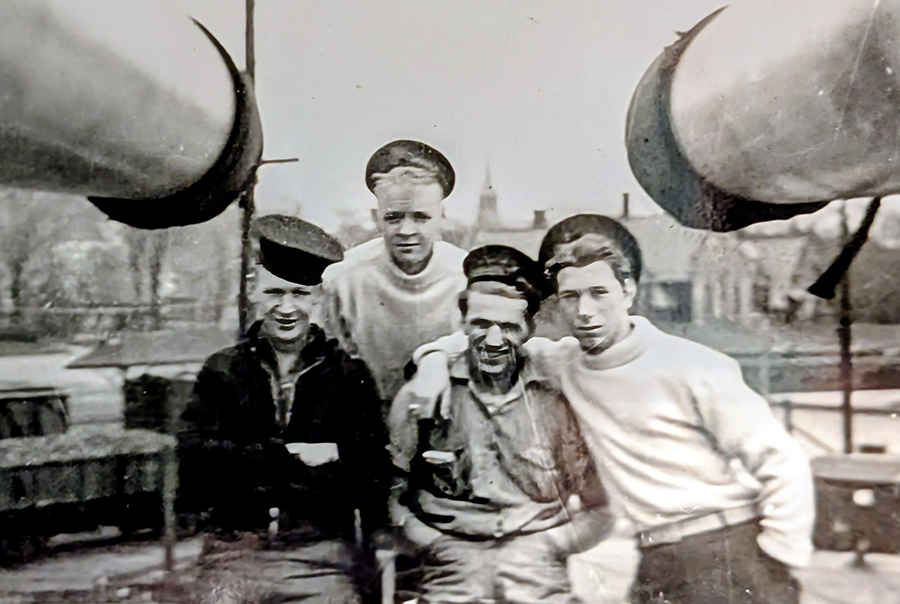
Les started as an ordinary seaman, but he was soon drawn below deck into the deafening, grease-slicked belly of warships. “I was in the engine room on minesweepers and escorts,” he says. The work was hot and hazardous, but Les didn’t mind. “I was young and having lots of fun with other young men.”
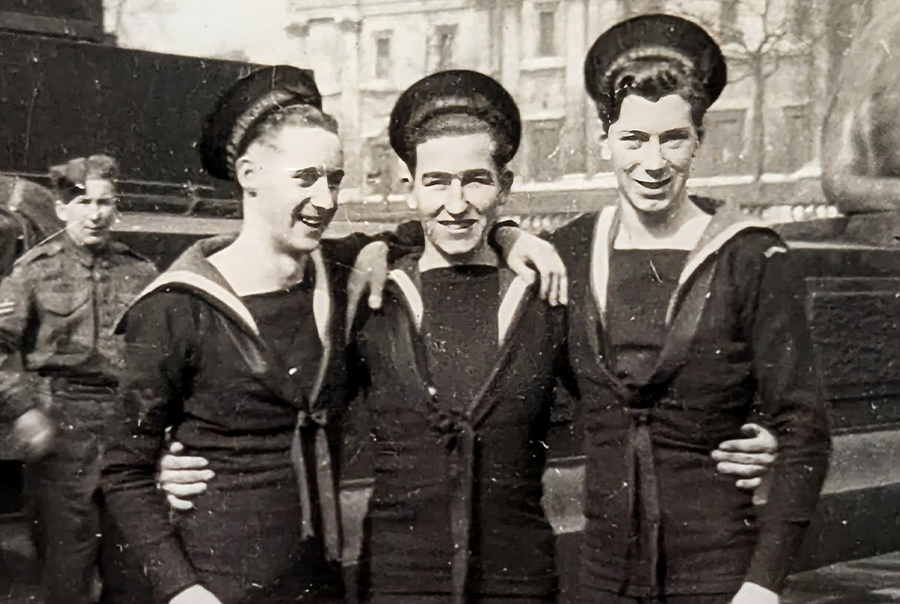
Sporting a youthful, wispy beard and the nickname “Little Lord Nelson,” he served aboard ships like the cruiser HMS Phoebe , the minesweeper HMS Elgin , and the frigate HMCS Springhill. Les ran treacherous convoy routes between Liverpool and Gibraltar, ventured north through the Hebrides and the Faroe Islands, and sailed south into North Africa and Malta.
Diesel Fumes, Deep Diving, and “Mutton Stew”
He operated with the British Royal Navy—a deployment that left him with a lasting impression of British cuisine. “We sailed with them, worked with them, and ate mutton stew,” he laughs. “They were keen on the mutton.” Les, himself, wasn’t so keen.
He trained as a Petty Officer in Devonport in 1943 and qualified as a naval deep-sea diver in Halifax in 1944. Strapped into heavy canvas suits and brass helmets, he worked beneath the surface of the ocean. When asked if he ever felt in danger on those dives, Les now recognizes the invincibility of youth: “In later years I thought, ‘Why did I ever do this?’ But when you’re young, you don’t think about danger. All you’re thinking about is getting ashore to have some fun.”
High Stakes and Light Moments
Convoys meant two weeks out at a stretch—“the same thing day in, day out, until the ship broke down.” To break up the monotony, the crew found amusement wherever they could—including the ship’s dog. “He liked rum,” Les remembers. “Every day a different guy would give him a little rum in his milk. If the water was rough and the ship rolled, he’d roll from one side to the other because he couldn’t keep his footing. We did stupid things like that.”
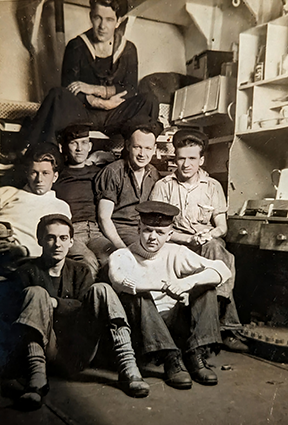
Yet the gravity of the war was never far away. Les recalls that in the spring of 1944 the fleet went on high alert. “Leaves were cancelled, and we knew there was something happening.” Les and his crew spent those tense days prepping the ship around the clock for D-Day.
By the time he was discharged in November 1945 as an Acting Senior Petty Officer and Diver, Canada had built the third-largest navy in the world. And Les was honoured to be associated with it. “I was pretty proud. To walk around with ‘Canada’ on your shoulders and everyone knew who you were; I was proud to be part of it.”
A Partnership of Service: Life with Joan
Returning home, Les worked odd jobs until finding his post-war calling: the Vancouver Fire and Rescue Services. He met a fellow veteran, Joan, who also lived in Kitsilano Beach and the two married in 1948.
They settled in Richmond to raise their three children and embraced an active, joyful life together. Les dedicated 31 years to the department, rising to the rank of Captain. His lifetime of service earned him the Meritorious Fire Service Medal and the Queen Elizabeth II Diamond Jubilee Medal.
After Les retired at 59, they travelled widely. “She travelled a lot,” Les jokes. “I just carried the bags.” Avid square dancers, Les and Joan spent more than 40 years do-si-do-ing across dance halls with the Richmond Star Promenaders . Les was also actively involved with the Masons, in their church community. Life brought Les full circle back to Ladner, where he lived for 22 years before moving into The Waterford Seniors Community in Tsawwassen in 2011.
A Century Well Lived
Today, his veteran’s jacket tells the story of his wartime courage: the Defence of Britain Medal, the Canadian Volunteer Service Medal, the War Medal 1939–1945, and the France and Germany Star. Through the years, Les took his place at the local Legion and marched in Remembrance Day parades, and represented a generation that stepped up when the world needed them most.
When asked what it felt like to be recognized year after year by a grateful public, his humility shines through: “Well, you found out you were a veteran, and that you were special.” Les is a reminder of the real individuals behind the poppy—the young people who left family farms and beachside towns to step into boiler rooms, rough seas, and uncharted waters. They answered the call of duty, looked out for their mates, and came home to build the communities we live in today.
When asked how he approaches the days ahead, Les brings the no-nonsense wisdom of his generation to bear: “I’m just going to carry on.”
This Remembrance Day, we pause to say thank you to Les, to Joan, and to every veteran who served and is still serving today.
Comments